 The Building Site
Round Towered Churches
In an article for Country Living in May 2002
we wrote:
Round towered churches are rarely found outside England, indeed they are peculiar to Norfolk and Suffolk. One old story goes that they were built as wells, then sea level fell and, wasting nothing, local people filled them with bells and built on an aisle.

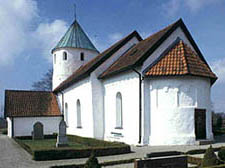
Closer to the truth perhaps is to observe the paucity of building stones in East Anglia and the resourceful use of naturally knobbly flint, which, though strong, gives all kinds of problems if you try to build corners. Both story and prosaic explanation are part of the inventiveness of the place.
This brought a thoughtful response from Caroline Davison, who works in building conservation in Norfolk County Council:
"The paucity of building stone theory has been largely discounted by recent research. In fact, many of the church naves, which often pre-date the round towers, use flints as perfectly adequate quoins for square corners. In addition, many of the round towers are partially built from an indigenous stone called ferrugenous conglomerate which is also perfectly adequate for making square corners - but the builders chose not to use it that way.
We believe now that the towers were built round for cultural reasons - when the round towers were being built the county had stronger links with the coastal communities around the Baltic and North Seas than with the rest of England. There were strong trading links, and a shared Scandinavian legacy. In fact, the idea of building round towered churches seems to have spread from north Germany along trade routes. There are very similar round towers in the north German regions of Lower Saxony and Schleswig Holstein,the former Danish region of Skane (now Southern Sweden), Norway and the Orkney Isles.


Round towers were first seen in East Anglia at Bury St Edmunds Abbey and Norwich cathedral, and then the idea seems to have filtered down to parish churches, along with other characteristic features, such as double splayed windows.
At Great Leighs in Essex, there is a motif used around the church door which is exactly replicated in a Danish church, proving the direct link with this region and Scandinavia.
I think it is interesting in itself that the paucity of stone theory has been so accepted in to local belief, even though there is so much evidence to counter the argument. But also I think it is an exciting aspect of local distinctiveness that it can often be a potent mix of local and outside influences. This emphasises an historic acceptance and absorption of the new which has relevance to our modern day culture."
Stephen Heywood of Norfolk County Council carried out the original research which supports this theory.
Picture credits:
1st row: Left, Hales (East Anglia); Right, Hammarlunda (southern Sweden).
2nd row: Plait motif used (left) at Great Leighs in Essex and again (right) at the church at Neukirchen in north Germany, formerly Denmark.
Photos by Caroline Davison.
Drawing by Clifford Harper.
The Round-Towered Churches Society have a web-site


